
Mind Maps
Mercantilism
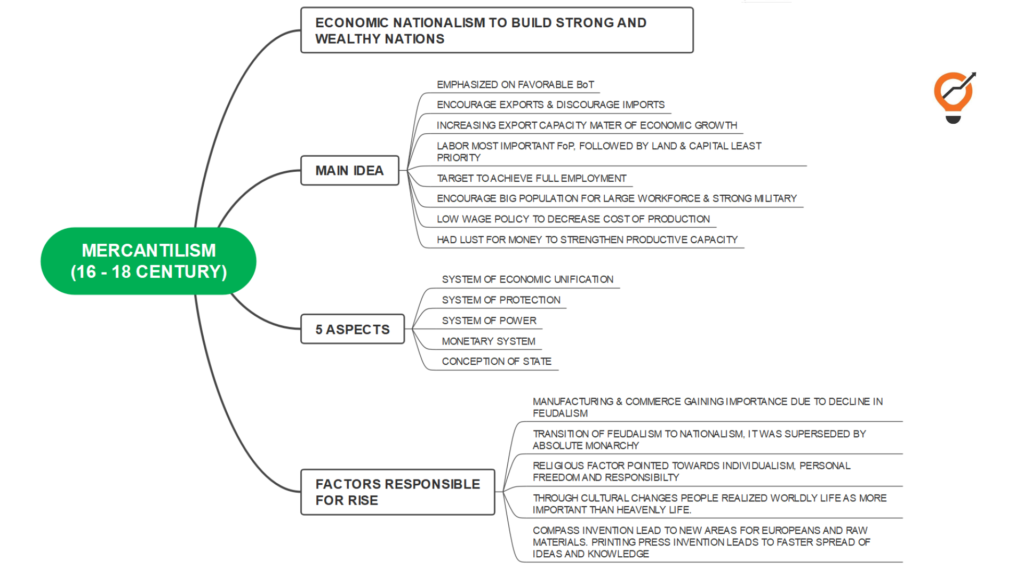
Mercantilism, an economic doctrine prevalent from the 16th to 18th centuries, aimed at building strong and wealthy nations through economic nationalism. Key ideas of mercantilism included the encouragement of a large population to provide a strong workforce and army, the provision of subsistence-level wages for laborers, the belief that international trade was a zero-sum game, and the emphasis on maintaining a favorable balance of trade by promoting exports and restricting imports. Mercantilists outlined five aspects of their economic system: economic unification, protectionism, concentration of power, a monetary system, and the conception of the state. The rise of mercantilism was influenced by the growing importance of manufacturing and commerce, the transition from feudalism to nationalism, religious factors promoting individualism and personal freedom, cultural changes prioritizing worldly pursuits, and technological advancements like the compass and printing press, which facilitated exploration and the spread of knowledge and ideas.
Physiocracy
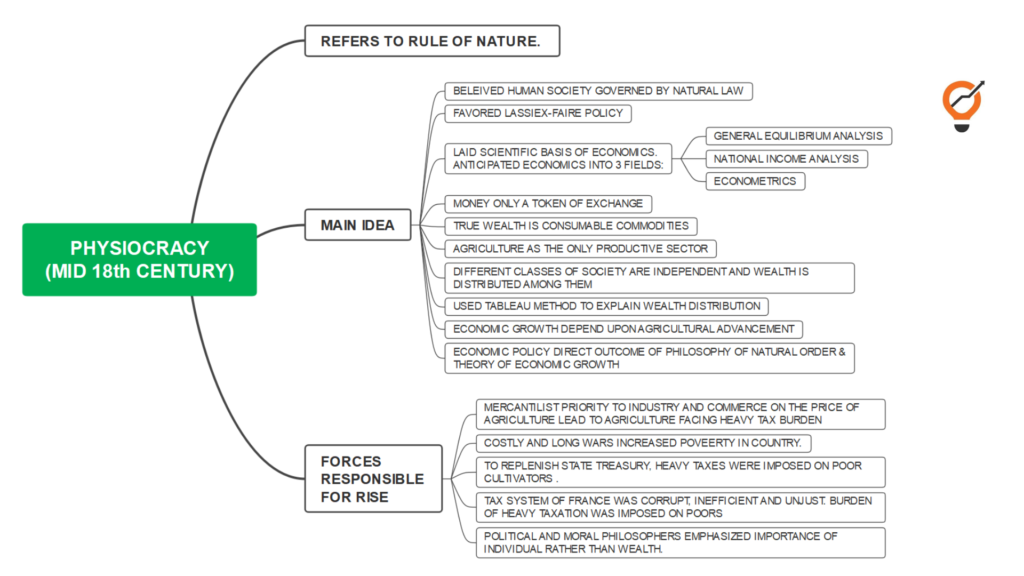
Physiocracy, a school of thought in economics, emerged in the 18th century and advocated for the rule of nature in governing economic systems. Its main tenets include the belief that agriculture is the sole productive sector and that economic growth relies heavily on the success of the agricultural industry. Physiocrats utilized the “tableau économique” to illustrate the distribution of wealth within society. They emphasized the importance of a natural order and sought to align economic policies accordingly. The factors that contributed to the rise of physiocracy include the neglect of agriculture by mercantilism, food shortages resulting from costly European wars, and the corrupt tax system in France
Classical School of Thought

The classical school of thought in economics, prominent in the 18th and 19th centuries, was characterized by its focus on economic growth and advocacy for a laissez-faire policy. Key features included the belief that individual welfare contributes to societal welfare, adherence to the doctrine of laissez-faire or economic liberty, and the recognition of population growth and capital accumulation as crucial for overall economic progress. The classical economists divided growth theories into three categories: the optimistic theory of growth put forth by Adam Smith, the pessimistic theories by Thomas Malthus and David Ricardo, and the moderate economic theory presented by JS Mill. They proposed influential theories such as Say’s law of market, the theory of value, the theory of distribution, the Malthusian theory of population, and theories of international trade that led to specialization in commodity production.
Adam Smith

Adam Smith, a renowned economist of the 18th century, was influenced by the liberal trade ideas of later mercantilists and the slogans of liberty, equality, and fraternity that emerged during the American Independence movement. His key ideas included the concept of the “invisible hand” representing the natural order of the market, advocating a laissez-faire policy of minimal government intervention. Smith believed that the wealth of nations could be increased by improving the quality and quantity of productive labor and emphasized the productivity gains from division of labor. He suggested that the role of the government should be limited to defense, justice, public works, and public institutions. Smith delved into the theory of value, exploring the labor theory of value and the cost of production theory of value. He also developed a theory of economic growth that included factors such as the production function, growth of the labor force, and capital accumulation. Additionally, Smith discussed and gave views on the distribution of rent, wages, interest, and profits within an economy but did not gave a proper theory of distribution.
Thomas Malthus
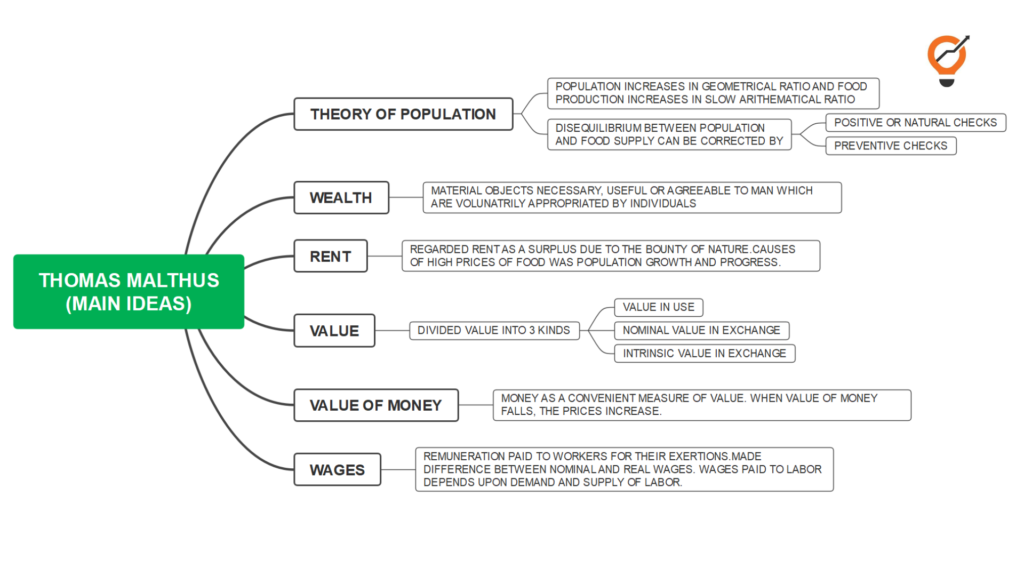
Thomas Malthus, an influential economist of the 18th and 19th centuries, is best known for his theory of population. He argued that while population increases at a geometric rate, food production only grows at a slower arithmetic rate, leading to potential overpopulation and scarcity. Malthus also shared his perspectives on various economic aspects, including wealth and the distribution of rent. He categorized value into three types: value in use, nominal value in exchange, and intrinsic value in exchange. Additionally, he discussed the concept of the value of money and its impact on price changes. Malthus considered the wage payment system in relation to the supply and demand of labor. His ideas on these subjects contributed significantly to economic thought during his time.
David Ricardo
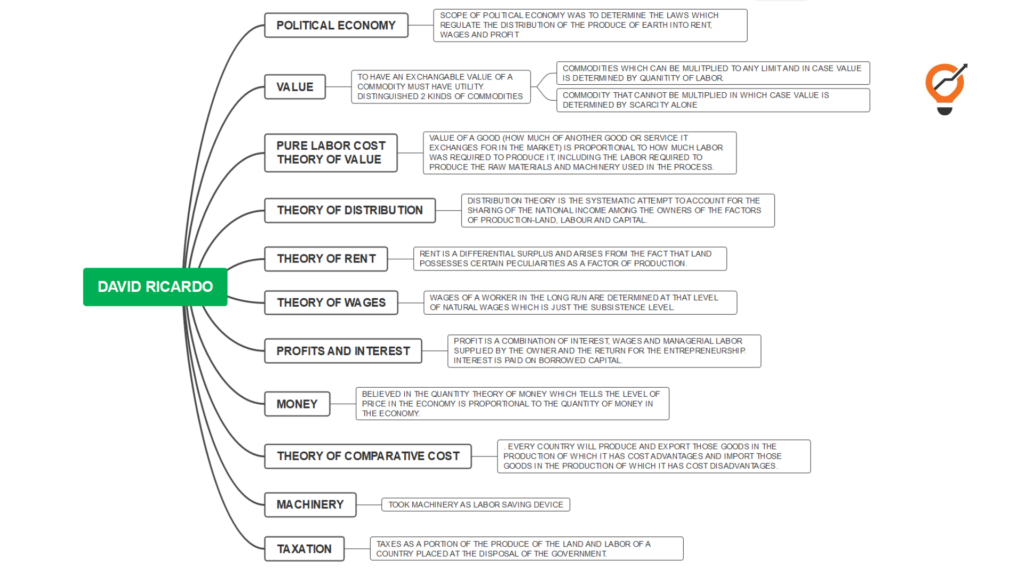
David Ricardo, a prominent political economist of the 19th century, made significant contributions to economic thought. He proposed the pure labor cost theory of value, asserting that the value of a good is directly related to the amount of labor required for its production. Ricardo also formulated the theory of distribution, which aimed to explain how the national income is distributed among the factors of production, namely land, labor, and capital. His most renowned work was his theory of rent, which argued that rent arises from the unique characteristics of land as a factor of production. In his theory of wages, Ricardo posited that in the long run, labor receives a natural wage rate equal to the subsistence level. His theory of international trade says, that each country should produce and export goods in which it holds a cost advantage, based on factors such as climate, natural resources, and the characteristics of its people. Additionally, he viewed taxes as a portion of the produce generated by land and labor within a country. Ricardo’s ideas continue to shape economic thinking to this day.