
Multiplier
- The multiplier is a key concept in Keynesian economics that explains how a change in autonomous spending (such as investment, government expenditure, or exports) leads to a larger change in national income or output. It shows the process through which an initial increase in spending can have a magnified effect on the economy, leading to a greater overall increase in aggregate demand and economic activity
- The Multiplier effect refers to the concept that an initial change in autonomous spending (such as government expenditure or investment) leads to a larger change in national income and output.
- The size of the multiplier depends on the marginal propensity to consume (MPC). The greater the MPC, the larger the multiplier.
- Formula: Multiplier=1/1−MPC
- For example, if the government spends on building infrastructure, workers and suppliers receive income, which they spend on other goods, thus generating further economic activity.
Mechanism of the Multiplier:
The multiplier effect works as follows:
- When the government increases spending (for example, on infrastructure), the immediate effect is a rise in aggregate demand.
- The firms producing the goods and services for the government spend that income on wages, materials, and other inputs.
- The individuals receiving this income (wages, profits) will spend a portion of it on consumption.
- As income increases, consumption increases, leading to more demand for goods and services, which in turn generates further income and consumption in the economy.
This process repeats itself several times, and the total increase in national income is a multiple of the initial increase in spending.
Types of Multipliers:
- Government Spending Multiplier: This measures the change in national income resulting from an increase in government expenditure. A government spending multiplier greater than 1 means that for every dollar of government spending, national income increases by more than one dollar.
- Investment Multiplier: This shows how changes in private sector investment lead to changes in income. An increase in investment boosts income, which leads to higher consumption and further investment.
- Tax Multiplier: This measures the effect of a change in taxes on national income. A tax cut increases disposable income, which increases consumption, thereby increasing aggregate demand and income. Tax multipliers are typically smaller than government spending multipliers, because part of the income saved from tax cuts is not immediately spent.
Factors Affecting the Multiplier:
Several factors influence the size of the multiplier effect:
- Marginal Propensity to Consume (MPC): The higher the MPC (the proportion of income spent on consumption), the larger the multiplier effect. A higher MPC means that individuals spend more of their income, leading to greater increases in demand and income.
- Tax Rates: High taxes reduce disposable income, limiting the amount available for consumption and reducing the multiplier. Lower taxes increase disposable income and can lead to a larger multiplier effect.
- Interest Rates: The level of interest rates can affect investment and consumption. Lower interest rates typically stimulate investment and consumption, leading to a larger multiplier.
- Imports: If a significant portion of income is spent on imports, the multiplier effect will be smaller, as money spent on imports does not stay within the domestic economy.
- Inflation: If the economy is near full capacity, increases in demand can lead to inflation rather than increases in real output, which can reduce the effectiveness of the multiplier.
- Consumer and Business Confidence: If businesses and consumers are confident about the future, they are more likely to spend and invest, leading to a larger multiplier.
Balanced Budget Multiplier
The Balanced Budget Multiplier (BBM) is a concept from Keynesian economics that shows how government fiscal actions can affect the national income even when the budget remains balanced. In simple terms, it tells us what happens to the economy when the government increases its spending and taxes by the same amount.
At first glance, one might assume that increasing government expenditure and taxes by an equal amount would cancel each other out and have no effect on overall income. But in reality, the economy actually experiences an increase in income equal to the amount of government spending. This surprising outcome is what the Balanced Budget Multiplier captures—and it’s usually equal to 1.
How It Works: The Logic Behind It
Let’s consider a simple example:
Imagine the government increases both its spending and taxes by ₹100 crores.
- Government Spending Effect:
When the government spends ₹100 crores—for example, on infrastructure—it injects that money directly into the economy. This expenditure becomes someone else’s income (say, wages for construction workers), who will then spend part of it, further creating income for others. This chain of spending is known as the multiplier effect. The initial ₹100 crores results in a more-than-₹100 crores increase in total income, depending on how much people spend from their income (their marginal propensity to consume or MPC). - Taxation Effect:
At the same time, if the government collects ₹100 crores in taxes, people’s disposable incomes fall. However, the entire ₹100 crores is not withdrawn from the consumption stream. Why? Because people don’t spend all their income—some of it is saved. So if the MPC is 0.8, people will cut their consumption only by ₹80 crores (and save ₹20 crores less), softening the contractionary impact of taxation.
Thus, while taxes reduce consumption by a fraction (₹80 crores in this case), government spending increases aggregate demand by the full ₹100 crores. This imbalance leads to a net increase in income, and that increase equals the amount of government spending.
Mathematical Derivation
We can express the Balanced Budget Multiplier using this formula:
Balanced Budget Multiplier=Government Expenditure Multiplier−Tax Multiplier
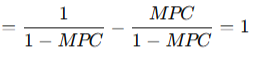
So regardless of the value of the MPC, the Balanced Budget Multiplier equals 1, meaning a ₹100 increase in both spending and taxes leads to a ₹100 increase in national income.
Leakages in the Multiplier Process
The multiplier process in Keynesian economics describes how an initial increase in autonomous spending (like government investment or private investment) leads to a more-than-proportional increase in national income due to repeated rounds of spending.
However, this process does not continue indefinitely. In each round, a portion of the income earned is not re-spent on goods and services. This portion that is withdrawn from the circular flow of income and expenditure is known as a leakage. Leakages reduce the value of the multiplier and slow down the pace of income generation.
Let’s understand each major type of leakage in detail:
1. Savings
Savings are the most fundamental leakage in the multiplier process. When people receive additional income, they typically do not spend the entire amount. A portion is saved.
For example, if the Marginal Propensity to Consume (MPC) is 0.8, it means that people spend 80% and save 20% of their additional income. The more people save, the smaller the multiplier effect, because less money is being re-circulated in the economy through consumption.
The higher the marginal propensity to save (MPS), the lower the multiplier.
2. Imports
When people buy foreign goods and services, the money flows out of the domestic circular flow and does not contribute to domestic income.
For example, if households spend a part of their income on imported electronics or travel abroad, the resulting income benefits producers in other countries, not the domestic economy.
This is particularly important in open economies, where high import dependence can significantly dampen the multiplier effect.
3. Taxation
Taxes reduce the disposable income of households and firms. With less disposable income, people spend less, and hence the consumption-led income generation process weakens.
For instance, a high income tax rate or indirect taxes like GST reduce how much of the additional income is actually available to be spent, thereby lowering the subsequent rounds of spending in the multiplier chain.
4. Hoarding of Money
Sometimes, instead of spending or saving in banks, people may hoard cash—keeping it idle under mattresses, in lockers, etc. This money does not enter the banking system or contribute to demand.
Hoarded money is non-productive and completely interrupts the flow of income and expenditure. It acts as a complete leakage from the multiplier process.
5. Debt Repayments
If people use a part of their additional income to repay past loans, this amount is not spent on goods or services, and hence, does not contribute to further rounds of income generation.
Although repaying debt improves financial health in the long term, in the short term, it removes money from active circulation, slowing down the multiplier process.
6. Undistributed Profits
Firms sometimes retain a portion of their profits rather than distributing them as dividends or reinvesting immediately. These retained earnings are often held for future expansion or as reserves.
Since undistributed profits do not enter the hands of consumers or workers, they reduce immediate spending and act as a leakage from the multiplier chain.