IES vs RBI DEPR: Which One Should You Go For?
You’ve just finished — or you’re about to finish — your MA or MSc in Economics. Someone tells you: “You should sit for IES or RBI DEPR.” You nod. And then you spend the next three hours on Google trying to figure out what the actual difference is, because every article either gives you a dry syllabus comparison or reads like it was written by a government circular.
This one won’t do that. I’ve spent over a decade helping economics postgraduates navigate exactly this decision, and I’m going to give you the honest version — salary, work life, preparation overlap, and which career actually fits which kind of person.
Summary — If You Only Have 60 Seconds
- Both exams have identical eligibility — PG in Economics, age 21–30. If you’re in your final year of MA/MSc Economics, you can appear in both right now.
- IES is a UPSC exam. You become a government economist working across Indian ministries. Descriptive, broad, policy-oriented.
- RBI DEPR is conducted by the RBI itself. You become a monetary economist doing research inside India’s central bank. More analytical, more focused.
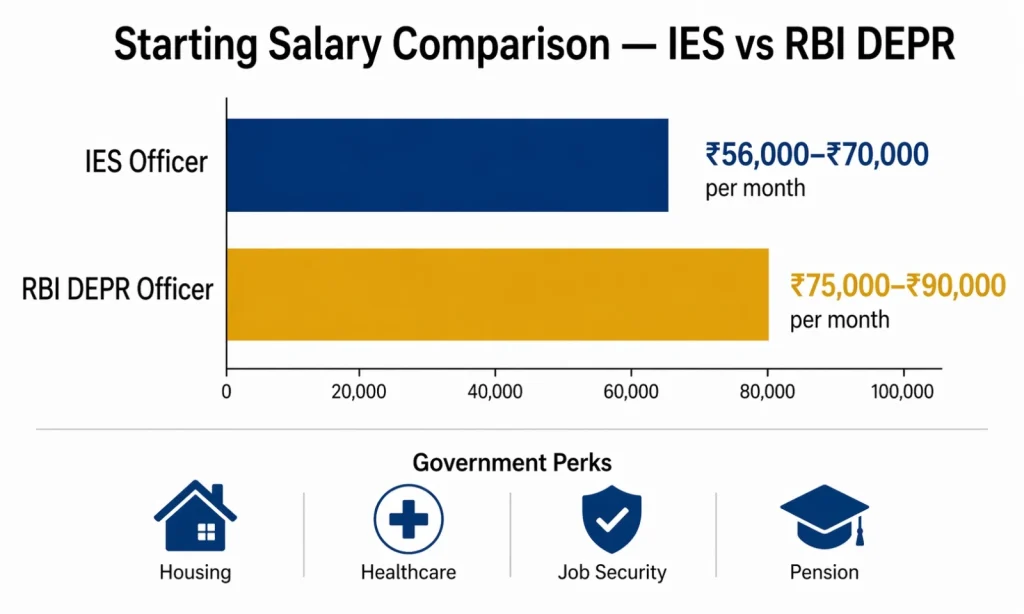
- Salary: IES in-hand starts at ₹56,000–70,000/month. RBI DEPR starts higher at ₹75,000–90,000/month. But IES perks add significant hidden value.
- Preparation overlap is 60–70%. Preparing for one seriously means you’re already halfway ready for the other. Smart aspirants appear in both.
What is IES?
The Indian Economic Service is a Group A Central Service under the Government of India. It is conducted by UPSC — the same organisation that runs the IAS exam — every year. When you clear IES, you join as a Junior Time Scale officer and get posted across Indian ministries: Finance, Commerce, Agriculture, NITI Aayog, DPIIT, and several others.
Your job, put simply, is to be the government’s economist. You analyse data, write policy notes, prepare inputs for the Economic Survey, and help ministries make evidence-based decisions. Over a long career, IES officers can reach Joint Secretary-level positions, contribute to landmark policy, and even go on international deputation to institutions like the IMF or World Bank.
Think of IES as the career where your economics degree shapes India’s public policy — from inside the system.
What is RBI DEPR?
DEPR stands for Department of Economic and Policy Research — it is the research wing of the Reserve Bank of India. RBI conducts its own recruitment exam for Research Officers in DEPR. This is not a UPSC exam.
As a DEPR officer, you work within the RBI — India’s central bank — on monetary policy research, banking sector analysis, inflation modelling, the balance of payments, and India’s external sector. The RBI publishes the Annual Report, the Monetary Policy Report, and numerous working papers largely through DEPR’s work. Your research, quite literally, informs decisions like the repo rate.
Think of RBI DEPR as the career where your economics degree shapes India’s monetary and financial system — from inside the institution that controls it.
Eligibility — And Yes, Final Year Students, This Applies to You Too
This is where I want to be very direct, because this doubt holds back a lot of bright students unnecessarily.
For IES: You need a postgraduate degree in Economics, Applied Economics, Business Economics, or Econometrics from a recognised university. Age must be between 21 and 30 years. General category students get 6 attempts, OBC gets 9, and SC/ST candidates have unlimited attempts.
For RBI DEPR: A postgraduate degree in Economics, Econometrics, Quantitative Economics, Mathematical Economics, or Finance with Economics from a recognised university. Age limit is broadly 21–30 years as well, with standard relaxations.
Now, the important part for final year students: UPSC explicitly allows candidates who are in their final year of a qualifying PG degree to appear for IES. You do not need to wait until your result is declared. You appear in the exam now, and if selected, you produce your degree certificate at the time of joining. RBI DEPR has a similar provision for final year students.
This means if you are sitting in your last semester of MA Economics right now, you have no reason to wait. Your PG preparation is already aligned with both exam syllabi. Start now, attempt both, and use your final year coursework as your foundation. This is genuinely the best strategic position to be in.
Exam Pattern — Where the Two Paths Diverge Sharply
This is the section where most comparison articles get vague. Let me be specific.
IES Exam Pattern
IES is a written examination followed by a personality test (interview). There are six papers in the written stage:
- Paper I — General Economics I (Microeconomics, Mathematical Economics, Statistics & Econometrics) — 200 marks
- Paper II — General Economics II (Macroeconomics, International Economics, Growth) — 200 marks
- Paper III — General Economics III (Public Finance, Industrial Economics, Environmental Economics) — 200 marks
- Paper IV — Indian Economics — 200 marks
- Paper V — General English & Essay — 100 marks
- Paper VI — General Studies — 100 marks
Total written marks: 1,000. Personality test: 200 marks. Grand total: 1,200.
All papers are descriptive — you write answers in full sentences, use diagrams, cite data, and build structured arguments. There are no MCQs in the main exam. This is a critical point. Your ability to explain Keynesian economics clearly, draw a well-labelled IS-LM diagram, and connect theory to India’s current fiscal situation — that determines your rank more than anything else.
RBI DEPR Exam Pattern
RBI DEPR typically has a written test with both objective and descriptive components, followed by an interview. The written test has a stronger emphasis on research aptitude, quantitative analysis, economic data interpretation, and the ability to write structured analytical notes — essentially, can you think like a research economist?
The DEPR exam tests depth in monetary economics, banking, and macroeconomic modelling more than breadth across all areas. It also tends to reward candidates who can work with real data, interpret RBI reports, and write policy-relevant commentary.
The key difference in one line: IES tests whether you can be a broad, policy-aware government economist. RBI DEPR tests whether you can be a focused, research-driven monetary economist.
Salary & Perks — Real Numbers, No Vagueness
Let me give you the actual figures because you deserve to make this decision with accurate information.
IES Officer Salary (Starting — Junior Time Scale)
As per the 7th Pay Commission, an IES officer’s approximate monthly take-home, depending on posting city, breaks down as:
- Basic Pay: ₹15,600 (Pay Level 10 in the pay matrix, starting)
- Dearness Allowance (DA): Currently around 50% of basic
- House Rent Allowance (HRA): ₹8,000–18,000 depending on city (X, Y, Z classification)
- Transport Allowance: ₹3,200–7,200
Approximate in-hand: ₹56,000–₹70,000 per month, depending on your posting city. Delhi and Mumbai postings bring this to the higher end.
RBI DEPR Research Officer Salary
RBI operates on its own pay scale, which is more competitive than standard Central Government scales. A DEPR Research Officer’s approximate in-hand monthly salary sits in the range of ₹75,000–₹90,000, which includes RBI’s own DA, HRA for major cities, and additional allowances specific to RBI employees.
But here’s what the salary number alone doesn’t capture for IES:
Government housing (if allotted in Delhi) is worth ₹20,000–₹40,000 per month in rent saved. Free medical facilities for the officer and family. Leave Travel Concession. Government Provident Fund contributions. And a pension structure (NPS) that no private employer matches.
When you calculate total compensation including all perks, IES is more competitive than the raw salary number suggests — though RBI DEPR still holds a clear edge in direct cash terms. For IES vs RBI DEPR salary comparison, the gap narrows significantly when you account for the full benefits package.
Work Profile — This is the Real Deciding Factor
Salary you can adjust to. The nature of your work for 35 years — that’s what you need to get right.
A Day in the Life of an IES Officer
Depending on your ministry, the work looks quite different. In the Ministry of Finance, you might be working on a policy note about the fiscal multiplier effect of capital expenditure — collating data, drafting the analysis, and presenting it to senior officers who use it in Budget preparation. In NITI Aayog, you might be tracking SDG indicators for India and contributing to the Voluntary National Review report. In the Ministry of Commerce, you could be preparing India’s position papers for WTO negotiations or analysing the impact of a new bilateral trade agreement.
The work is intellectually substantive when you’re in the right ministry. But IES is also a government career — which means there are postings that are less exciting, bureaucratic processes that move slowly, and decisions that get made above your pay grade for non-economic reasons. That’s the honest version.
What makes IES unique is the variety. Over a 30-year career, you will likely work across 4–6 different ministries, have exposure to international economic diplomacy, potentially teach at IIPA or similar institutions, and contribute to documents that genuinely shape national policy. No private sector economics job offers that combination.
A Day in the Life of an RBI DEPR Officer
The environment inside RBI DEPR is arguably the most intellectually rigorous in Indian public service. Your colleagues are economists with PhDs and strong research backgrounds. The work involves analysing monetary data, building models, writing working papers, contributing to the Monetary Policy Report, and preparing briefs for the Monetary Policy Committee before each rate decision.
If you find yourself genuinely excited by questions like “What is the transmission mechanism of monetary policy in India and why does it work differently than textbook theory suggests?” — DEPR is where you want to be. The data access is exceptional, the research infrastructure is better than most Indian universities, and the peer environment is strong.
The trade-off is focus. DEPR officers have deep expertise in monetary and financial economics, but the breadth of experience that IES offers — working across agriculture, commerce, infrastructure, social sector — doesn’t exist in the same way within a central bank.
Preparation — The 60–70% Overlap That Changes Your Strategy
Here is the most practical insight in this article, and most aspirants either don’t know it or don’t act on it.
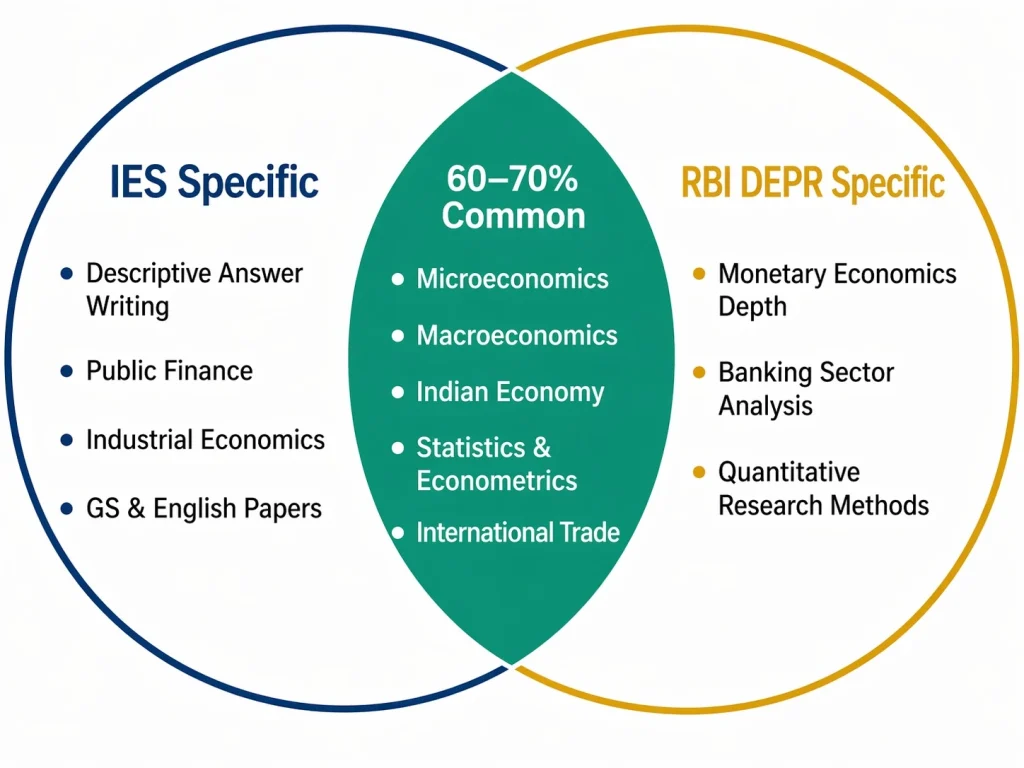
The preparation for IES and RBI DEPR overlaps by 60–70%.
The core economics — microeconomics, macroeconomics, Indian economy, statistics, public finance — is common ground for both exams. If you’re studying the IS-LM model for IES Paper II, that directly helps you in DEPR’s macroeconomics section. If you’re tracking RBI monetary policy decisions for DEPR, that feeds directly into IES Paper IV (Indian Economics) and Paper VI (General Studies).
Where they diverge is in emphasis and depth:
- IES needs you to go wider — cover public finance, industrial economics, environmental economics, general studies, and English essay writing. It requires stronger descriptive answer-writing skills.
- RBI DEPR needs you to go deeper in monetary economics, quantitative analysis, and research methodology. A candidate who can discuss monetary policy transmission, WALR data, and Basel III compliance fluently has an edge.
The smartest preparation strategy — and I have seen this work repeatedly — is to build the common economics core thoroughly in the first 8–10 months, and then spend the last 2–3 months before each exam tailoring specifically. For IES, you add intensive answer-writing practice and cover the GS and English papers. For DEPR, you go deeper into monetary economics and RBI-specific content.
One preparation. Two attempts. This is how serious aspirants approach it.
Who Should Choose What?
Go for IES if…
- You want a career that exposes you to the full breadth of India’s economic policymaking — not just one sector.
- You enjoy writing, structuring arguments, and communicating economic ideas clearly.
- The idea of working in the Ministry of Finance on Budget preparation, or at NITI Aayog on long-term development strategy, genuinely excites you.
- International deputation — working at the IMF, World Bank, or ADB for a 2–3 year stint — is something you aspire to.
- You’re comfortable with the reality of government service: stable, prestigious, structured, but sometimes slower-moving than you’d like.
- You want a career where your MA Economics degree is the foundation, not just a qualification.
Go for RBI DEPR if…
- Monetary economics is your genuine interest — you actually find questions about inflation targeting, currency dynamics, and banking sector stress interesting rather than just exam-relevant.
- You prefer a focused, research-intensive environment over a generalist policy role.
- Better starting salary and a career within one prestigious institution suits your personality more than posting-based variety.
- You have strong quantitative skills and enjoy working with data, econometric models, and research papers.
- The idea of your research informing India’s repo rate decisions and monetary policy stance — that’s the kind of impact that motivates you.
And if you’re asking “why not both?”
The honest answer is: please appear in both. The eligibility is the same, the preparation is 60–70% shared, and having two legitimate shots at a prestigious economics career is just rational planning. Many of the strongest IES officers I’ve interacted with appeared in RBI DEPR in the same cycle and cleared the written stage for both. Some chose IES; some chose DEPR. A few used the DEPR interview experience to sharpen their confidence before the IES personality test.
IES vs RBI DEPR — Complete Comparison Table
| Parameter | IES | RBI DEPR |
| Conducting Authority | UPSC | Reserve Bank of India |
| Educational Eligibility | PG in Economics / Applied Eco / Business Eco / Econometrics | PG in Economics / Econometrics / Quantitative Eco / Mathematical Eco |
| Age Limit | 21–30 years | 21–30 years |
| Final Year Students Can Apply? | ✅ Yes | ✅ Yes |
| Number of Attempts (General) | 6 attempts | Not specified (RBI recruits as needed) |
| Exam Type | Descriptive written + Interview | Objective + Descriptive + Interview |
| Number of Papers | 6 papers (written) + Personality Test | Written Test + Interview |
| Total Marks | 1200 (1000 written + 200 interview) | Varies by notification |
| Approximate Starting In-hand Salary | ₹56,000–₹70,000/month | ₹75,000–₹90,000/month |
| Government Housing | Available (based on posting) | RBI colony housing available in major cities |
| Work Nature | Policy formulation, ministry postings, generalist economist role | Monetary research, banking analysis, financial stability |
| Career Variety | High — multiple ministries over career | Focused — within RBI ecosystem |
| International Scope | High — IMF, World Bank, ADB deputation common | Moderate — RBI has international engagements |
| Exam Frequency | Annual (UPSC IES notification every year) | As per RBI recruitment calendar (not annual) |
| Preparation Overlap with Other Exam | 60–70% overlaps with RBI DEPR | 60–70% overlaps with IES |
| Best Suited For | Broad-minded policy economists who enjoy variety and public administration | Focused research economists with strong monetary and quantitative interest |
The Bottom Line
IES and RBI DEPR are both exceptional careers for an economics postgraduate — and the fact that they share the same eligibility is one of the great advantages of being where you are right now. You don’t have to choose between preparing for them. You have to choose which one you want more, and then let your preparation serve both simultaneously.
If you’re drawn to the breadth of India’s policymaking, the prestige of a UPSC-selected service, and the long arc of a career that touches agriculture, trade, finance, and international economics — IES is your calling. If you are genuinely passionate about monetary economics, research, and want to work inside the institution that controls India’s interest rates — RBI DEPR is where your mind will thrive.
And if you’re still figuring out which one fits you better — that’s exactly why counselling exists. The foundation is identical. The choice is personal. And with structured preparation, both are achievable.
🎯 Ready to Start?
Planning to prepare for IES 2025 or RBI DEPR?
Join Ecoholics.in’s free demo class and get a personalised study plan built around your current preparation level, your timeline, and which exam you’re targeting.
Whether you’ve just completed your PG or you’re in your final year of MA Economics — now is the right time to begin.
👉 Book Your Free Demo Class at Ecoholics.in
Download Customized Guide
No commitment. No fees. Just clarity on where to start.