Indian Economic Service Eligibility: Who Can Apply? (Final Year PG Students — Read This)
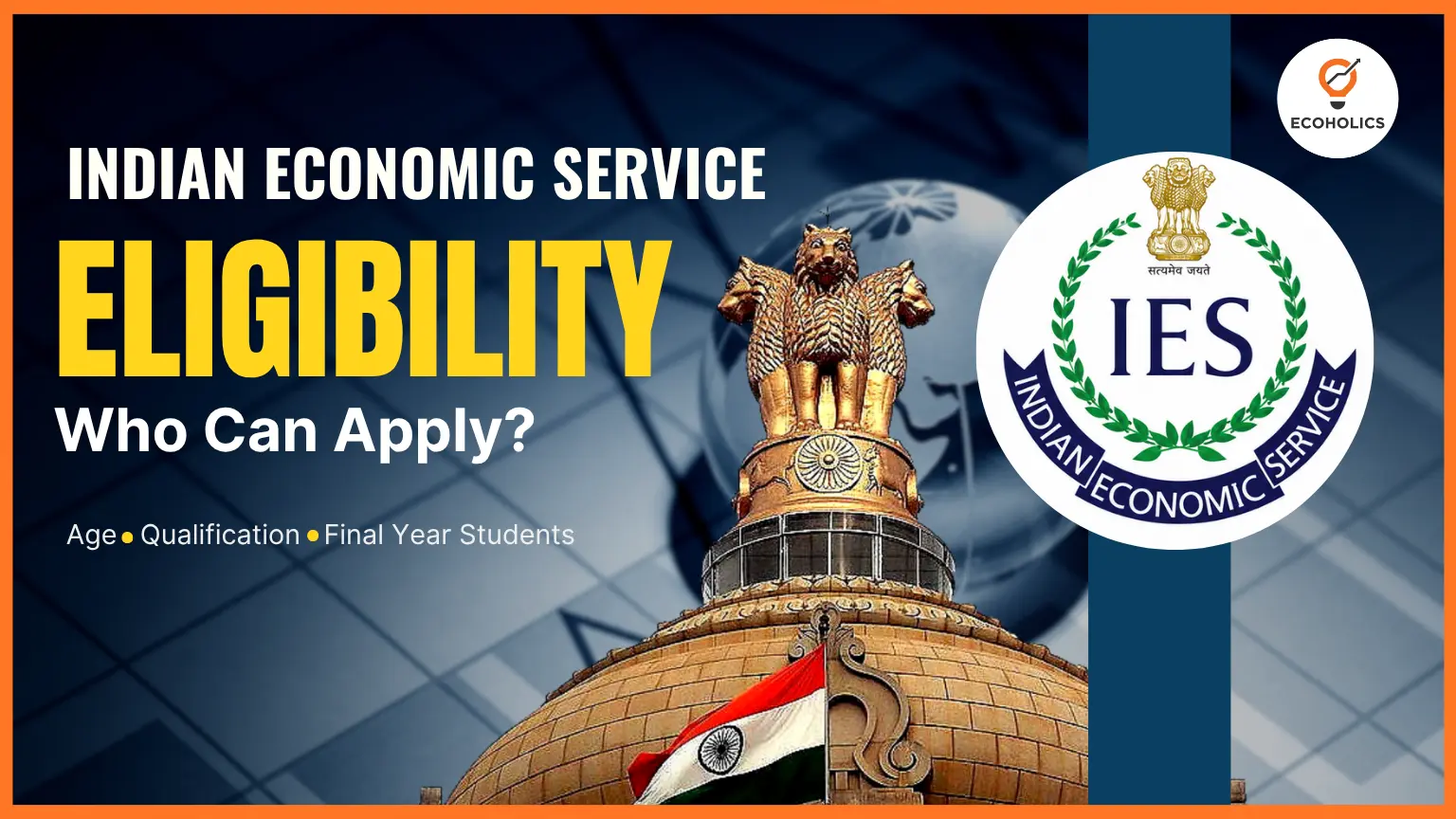
If you’re reading this, you probably have one question in mind — am I eligible to sit for the Indian Economic Service exam? The short answer is: if you have a postgraduate degree in Economics (or you’re in your final year of one), and you’re between 21 and 30 years of age — yes, you are eligible. Keep reading for the complete picture, including the final year student provision that most people don’t know about.
The Indian Economic Service exam eligibility criteria are actually simpler than most aspirants expect. The confusion usually comes from incomplete information online, not from the rules themselves. This guide covers every condition, every relaxation, and every edge case — so you can apply with confidence.
TL;DR — Eligibility at a Glance
- Degree: Postgraduate degree in Economics, Applied Economics, Business Economics, or Econometrics from a recognised Indian university
- Age: 21 to 30 years for General category, with relaxations for OBC, SC/ST, and PwD
- Attempts: 6 for General, 9 for OBC, unlimited for SC/ST (within the age limit)
- Final year students: Yes — UPSC allows you to appear if you are in your final year. You produce your degree certificate only at the time of joining, not at the time of application
- Documents needed at joining: Degree certificate, age proof, caste certificate (if applicable), and a medical fitness certificate
Educational Qualification — What Degree Do You Need?
The Indian Economic Service exam eligibility criteria for educational qualification are specific but not complicated. You need a postgraduate degree in one of the following disciplines from a recognised university in India:
- Economics
- Applied Economics
- Business Economics
- Econometrics
That covers the four accepted streams. If your PG degree is in any of these — whether from a central university, state university, or a deemed university with UGC recognition — you are educationally qualified.
A few important clarifications that come up frequently:
MA Economics vs MSc Economics — both are fine. Whether your institution offers the degree as MA or MSc does not matter. The discipline is what counts, not the degree nomenclature.
Distance education PG degrees are accepted, provided the university is recognised by UGC and the degree is valid for central government purposes. If you completed your MA Economics through distance mode from a recognised university like IGNOU or Annamalai University, you are eligible. If you are unsure whether your specific institution qualifies, check the UGC’s recognised institution list at ugc.ac.in.
Private universities are accepted, as long as the university has UGC recognition and your degree is a regular or distance PG in the required discipline.
What does NOT qualify: A BA Economics, BCom, MBA, or any undergraduate degree — regardless of how strong your economics background is. The minimum threshold is a full postgraduate degree in the specified disciplines. There are no exceptions to this.
Age Limit — Category-wise Breakdown
| Category | Minimum Age | Maximum Age |
| General (UR) | 21 years | 30 years |
| OBC (Non-Creamy Layer) | 21 years | 33 years |
| SC / ST | 21 years | 35 years |
| PwD — General | 21 years | 40 years |
| PwD — OBC | 21 years | 43 years |
| PwD — SC/ST | 21 years | 45 years |
Age is calculated as on the 1st of August of the examination year. So if the exam year is 2026, your age eligibility is checked as on 1st August 2026. This means if you turn 30 after 1st August 2026, you are still within the age limit for the 2026 cycle.
One important strategic note for General category aspirants: Your window is between 21 and 30 — a nine-year range that sounds comfortable but moves faster than you think. If you are 27 or 28 right now, treat this preparation cycle with urgency. You have three to four attempts remaining at most, and each year spent without a structured attempt is a year you don’t get back.
Number of Attempts
| Category | Number of Attempts Permitted |
| General (UR) | 6 attempts |
| OBC (Non-Creamy Layer) | 9 attempts |
| SC / ST | Unlimited (within age limit) |
| PwD — General | 9 attempts |
| PwD — OBC | 9 attempts |
| PwD — SC/ST | Unlimited (within age limit) |
An “attempt” is counted only when you actually sit for the written examination. If you apply but do not appear on the exam day, that is NOT counted as an attempt. So if you apply for a cycle but circumstances prevent you from appearing, you have not used up one of your attempts. This is worth knowing — applying early and often, even if you are not fully ready, is a low-risk strategy as long as you appear.
Can Final Year PG Students Apply for the Indian Economic Service? — Yes, and Here’s Exactly Why
This is the section most final year MA and MSc Economics students need to read carefully — because unnecessary confusion about this provision costs students an entire exam cycle.
The direct answer: Yes. Final year PG students are explicitly allowed to apply for and appear in the Indian Economic Service exam.
Here is what the UPSC provision states in practical terms: if you are currently in your final year of a qualifying postgraduate degree (MA Economics, MSc Economics, or equivalent), you can apply for the Indian Economic Service examination during the application window. You can sit for the written exam. You can appear for the personality test if shortlisted. And if you are ultimately selected and receive a joining order — that is when you are required to produce your original degree certificate.
Not at the time of application. Not at the time of the written exam. Not even at the time of the interview. Only at the time of joining — which typically falls several months after the final results are declared.
Why does this matter so much for you?
Because the Indian Economic Service exam cycle begins in March–April (notification) and the exam is held in June. If you are in your final semester right now, your semester exams are likely in April–May and your results come in June–July. By the time the Indian Economic Service written exam happens in June, many final year students haven’t even received their results yet — and that is completely fine. UPSC accounts for exactly this situation.
What this means strategically: If you are currently in your final year of MA or MSc Economics, you should apply the moment the notification opens. Do not wait for your result. Do not wait to collect your degree certificate. Apply now, sit for the exam, and use your final semester coursework — microeconomics, macroeconomics, Indian economy, econometrics — as the foundation for your preparation. You are literally studying the exam syllabus as part of your degree right now. That overlap is an advantage you should not waste.
One condition to be aware of: If you are selected and called for joining, you must produce your degree certificate showing you have successfully completed the qualifying PG degree. If for any reason you do not pass your final year exams, you would not be able to join — but you would have lost nothing except the exam fees, and your attempt count is only affected if you actually sat for the exam.
The bottom line: final year status is not a disqualification. It is a green light to appear now and prepare in parallel with your PG studies.
Documents You Need at the Time of Joining
When you receive your final selection order and are called for joining, you will need to produce the following documents:
- Degree certificate showing your qualifying postgraduate degree in Economics or related discipline
- Age proof — Class 10 certificate (birth date as recorded in board exam) is the standard document accepted by UPSC
- Caste certificate issued by a competent authority (Tehsildar or SDM level and above) — required for OBC, SC, and ST candidates
- PwD certificate — if applicable, issued by a designated Medical Board
- Medical fitness certificate — a fitness certificate from a government doctor confirming you meet the service’s medical standards
- Character certificate — from your last attending institution or a Gazetted Officer
You do not need to submit originals of most of these during the application stage. The application requires you to self-declare your eligibility. Original documents are verified only at the joining stage.
Who is NOT Eligible — Be Clear Before You Apply
Knowing who does not qualify saves you from applying unnecessarily and then facing rejection. The following categories are not eligible for the Indian Economic Service examination:
- BA or BCom graduates — regardless of how strong your economics background is, an undergraduate degree does not meet the qualification requirement
- MBA graduates — an MBA, even with a specialisation in Economics or Finance, does not qualify unless you separately hold a PG degree in Economics from a recognised university
- PG in non-listed disciplines — a Masters in Political Science, Sociology, Geography, or Commerce does not qualify, even if you studied economics papers as part of your degree
- Candidates above the age ceiling — if you have crossed 30 years (or the applicable relaxed age limit for your category) as on 1st August of the exam year, you cannot apply regardless of other qualifications
- Candidates who have exhausted their attempts — if you are a General category candidate who has already appeared 6 times, you are no longer eligible
- Candidates from unrecognised institutions — a PG degree from an institution not recognised by UGC does not qualify
If you fall into any of these categories and believe there may be an exception in your case, check the official UPSC notification directly — that is the definitive document, not any coaching institute’s interpretation of it.
Indian Economic Service Eligibility vs RBI DEPR — Are They the Same?
If you are eligible for the Indian Economic Service exam, you are almost certainly eligible for RBI DEPR as well.
RBI DEPR (Department of Economic and Policy Research) also requires a postgraduate degree in Economics or a related discipline (it additionally accepts Quantitative Economics, Mathematical Economics, and Finance with Economics) and has a similar age range of 21–30 years. Both exams share the same core eligibility profile, which is why serious aspirants appear in both simultaneously.
The preparation for both exams overlaps by 60–70%, and appearing in both in the same cycle is a widely followed strategy among economics postgraduates. Read our detailed comparison to understand which career suits you better: Indian Economic Service vs RBI DEPR — Which One Should You Go For?
Quick Eligibility Flowchart — Check Your Status in 60 Seconds
Are you between 21 and 30 years of age?
|
YES ──→ Do you have a PG degree in Economics / Applied Economics /
Business Economics / Econometrics?
|
YES ──→ Are you in your final year?
|
NO (completed) YES ──→ You can appear NOW.
| Submit degree cert at joining.
↓
✅ YOU ARE ELIGIBLE
Apply when UPSC notification opens.
|
NO ──→ Is your PG in a related field (Quantitative
Economics, Mathematical Economics)?
|
YES ──→ Check RBI DEPR eligibility
(broader qualification list)
NO ──→ ❌ Not eligible for IES.
Consider completing a qualifying PG.
|
NO ──→ Are you OBC / SC / ST / PwD?
|
YES ──→ Higher age limit applies. Check the table above.
NO ──→ ❌ Age condition not met for this cycle.
Frequently Asked Questions
Q1. Is a BA Economics degree sufficient to apply for the Indian Economic Service?
No. The Indian Economic Service exam eligibility criteria explicitly require a postgraduate degree. BA Economics, even from a reputed central university with first division marks, does not qualify. You must complete an MA, MSc, or equivalent postgraduate degree in Economics or a listed related discipline before you can apply.
Q2. Can I apply with a distance education MA Economics degree?
Yes, provided the university is recognised by UGC and the degree is treated as equivalent to a regular PG degree for central government purposes. Degrees from IGNOU, many state open universities, and recognised deemed universities through distance mode are accepted. The safest way to confirm is to check whether your specific institution appears on the UGC’s list of recognised universities at ugc.ac.in.
Q3. I am in my final year right now. What exactly do I need to do?
Apply when the UPSC notification opens (typically March–April). In the application form, you will find an option to declare that you are a final year student appearing for the qualifying examination. Tick that option, fill in your expected month of result, and submit. Appear for the exam normally. If selected, produce your degree certificate at joining. There is no disadvantage to applying as a final year student — the process is designed for exactly this situation.
Q4. I completed my MA Economics three years ago but never appeared for the exam. Have I used up any attempts?
No. Attempts are counted only when you actually appear (sit) for the written examination. Merely being eligible in previous years without applying — or applying but not appearing on the exam day — does not consume an attempt. Your attempt count is zero unless you have physically sat in the exam hall.
✅ You’re Eligible. Now What?
Knowing you qualify is step one. Step two is knowing what to do next — and that’s where most aspirants lose momentum.
Start here: How to Start Indian Economic Service Preparation — A Step-by-Step Beginner’s Roadmap
Or if you haven’t yet decided between the Indian Economic Service and RBI DEPR: Indian Economic Service vs RBI DEPR — Which One Should You Go For?
At Ecoholics.in, we run structured preparation batches for economics postgraduates — including a batch specifically designed for final year MA/MSc students who want to prepare alongside their semester exams.
👉 Book a Free Demo Class at Ecoholics.in
One free session. A clear plan for the next 12 months. No pressure.
Click here 👉